The Path Toward Scalable Quantum Computing: SEEQC’s Innovative Chip Solutions

The Path Toward Scalable Quantum Computing: SEEQC’s Innovative Chip Solutions

The Path Toward Scalable Quantum Computing: SEEQC’s Innovative Chip Solutions

By Dr. Shu-Jen Han, CTO, SEEQC

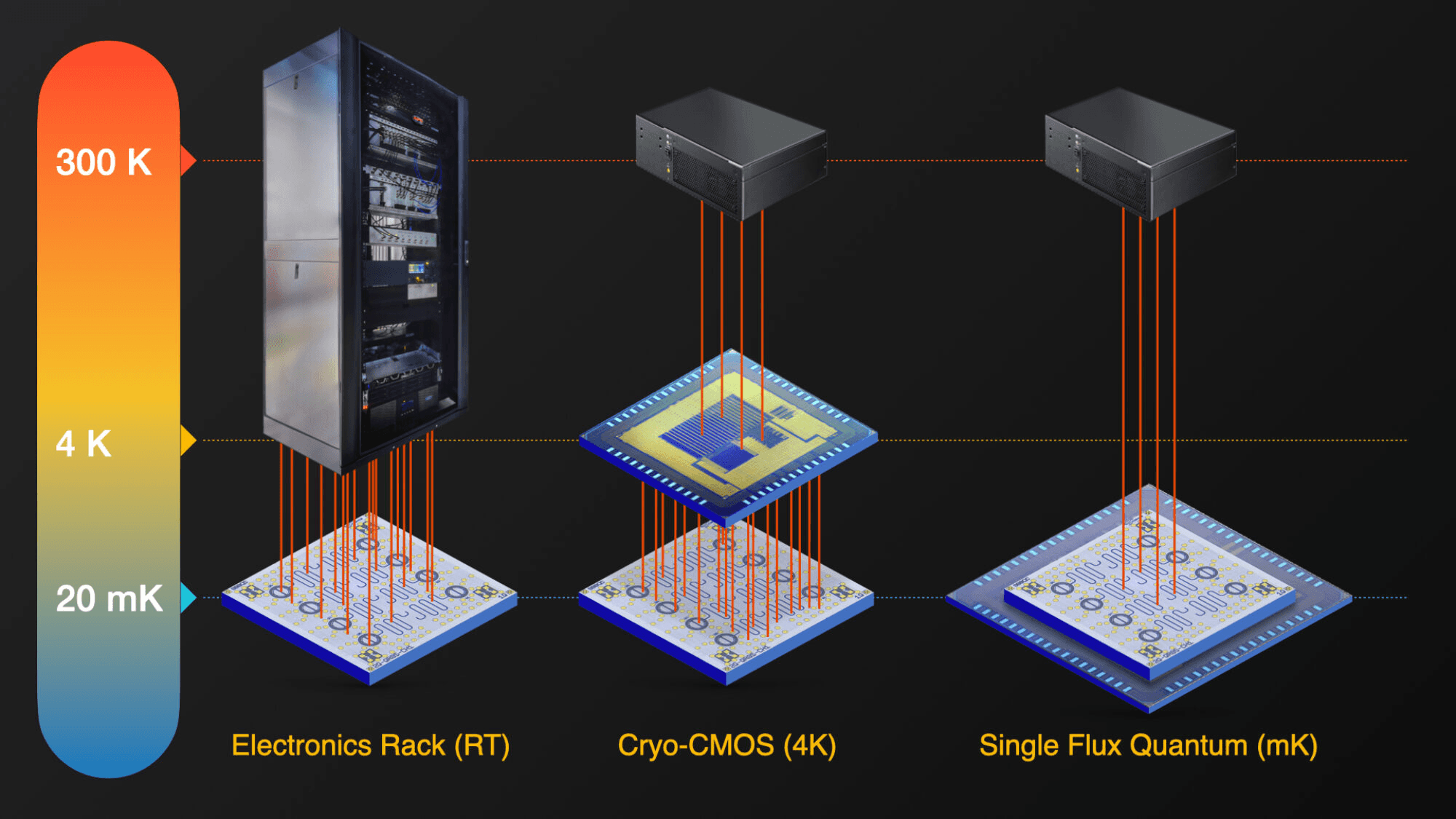
Today, researchers and engineers working in the field of superconducting based quantum computers agree that one of the biggest challenges of realizing a system beyond 1,000 – 10,000 qubits is the scalability of qubit control and readout electronics and associated wires and components. Current state-of-the-art quantum computers rely on racks of room temperature electronics to drive qubits sitting at the millikelvin stage, which is hardly scalable from the points of footprint and energy consumption. The integration level is just too low.

Highly integrated chip technology is the foundation of ever-increasing system performance and functionality in today’s CPU/GPU based computing platforms. Following this footstep in the microelectronic industry, quantum computing, to be scalable, needs to develop similar chip-based solutions by integrating key control and readout electronics directly with qubits on the same chip or through chip packaging technologies. However, the very limited cooling capacity at qubit operating temperature (10-20 mK) hindered the realization of this concept as any circuit implemented by conventional CMOS technology can easily heat up the system and destroy the qubit performance.
By Dr. Shu-Jen Han, CTO, SEEQC

Today, researchers and engineers working in the field of superconducting based quantum computers agree that one of the biggest challenges of realizing a system beyond 1,000 – 10,000 qubits is the scalability of qubit control and readout electronics and associated wires and components. Current state-of-the-art quantum computers rely on racks of room temperature electronics to drive qubits sitting at the millikelvin stage, which is hardly scalable from the points of footprint and energy consumption. The integration level is just too low.

Highly integrated chip technology is the foundation of ever-increasing system performance and functionality in today’s CPU/GPU based computing platforms. Following this footstep in the microelectronic industry, quantum computing, to be scalable, needs to develop similar chip-based solutions by integrating key control and readout electronics directly with qubits on the same chip or through chip packaging technologies. However, the very limited cooling capacity at qubit operating temperature (10-20 mK) hindered the realization of this concept as any circuit implemented by conventional CMOS technology can easily heat up the system and destroy the qubit performance.

By Dr. Shu-Jen Han, CTO, SEEQC

Today, researchers and engineers working in the field of superconducting based quantum computers agree that one of the biggest challenges of realizing a system beyond 1,000 – 10,000 qubits is the scalability of qubit control and readout electronics and associated wires and components. Current state-of-the-art quantum computers rely on racks of room temperature electronics to drive qubits sitting at the millikelvin stage, which is hardly scalable from the points of footprint and energy consumption. The integration level is just too low.

Highly integrated chip technology is the foundation of ever-increasing system performance and functionality in today’s CPU/GPU based computing platforms. Following this footstep in the microelectronic industry, quantum computing, to be scalable, needs to develop similar chip-based solutions by integrating key control and readout electronics directly with qubits on the same chip or through chip packaging technologies. However, the very limited cooling capacity at qubit operating temperature (10-20 mK) hindered the realization of this concept as any circuit implemented by conventional CMOS technology can easily heat up the system and destroy the qubit performance.